
The best detailing happens before wear becomes permanent
A day on the water around Fajardo, Culebra, Vieques, or the southern coast leaves more behind than memories. Salt settles into seams and hardware. Sunscreen transfers to upholstery. Drinks, bait, sand, and bare feet affect different surfaces in different ways. Under Caribbean heat, residue dries quickly and becomes harder to remove.
That is why the most effective marine-care routine begins soon after returning to the dock. The goal is not to make every trip feel like a full restoration. It is to remove the damaging residue, allow the vessel to dry properly, and notice changes before they become expensive.
Treat every surface according to what it is
Fiberglass and gelcoat can look durable while still being vulnerable to oxidation and improper chemicals. Stainless hardware benefits from fresh-water rinsing and drying, but rust staining may require a material-safe process. Acrylic windows need exceptional care: ordinary glass cleaner, paper towels, or a rough cloth can create haze and fine scratches that become obvious in direct sun.
Marine upholstery has its own rhythm. Dirt often gathers in stitching, piping, seat bases, and areas touched by sunscreen. Saturating cushions can trap moisture and invite odor or mildew. Controlled product use, soft agitation, extraction when appropriate, and complete drying are more important than using the strongest cleaner available.
A rinse is the beginning, not the whole job
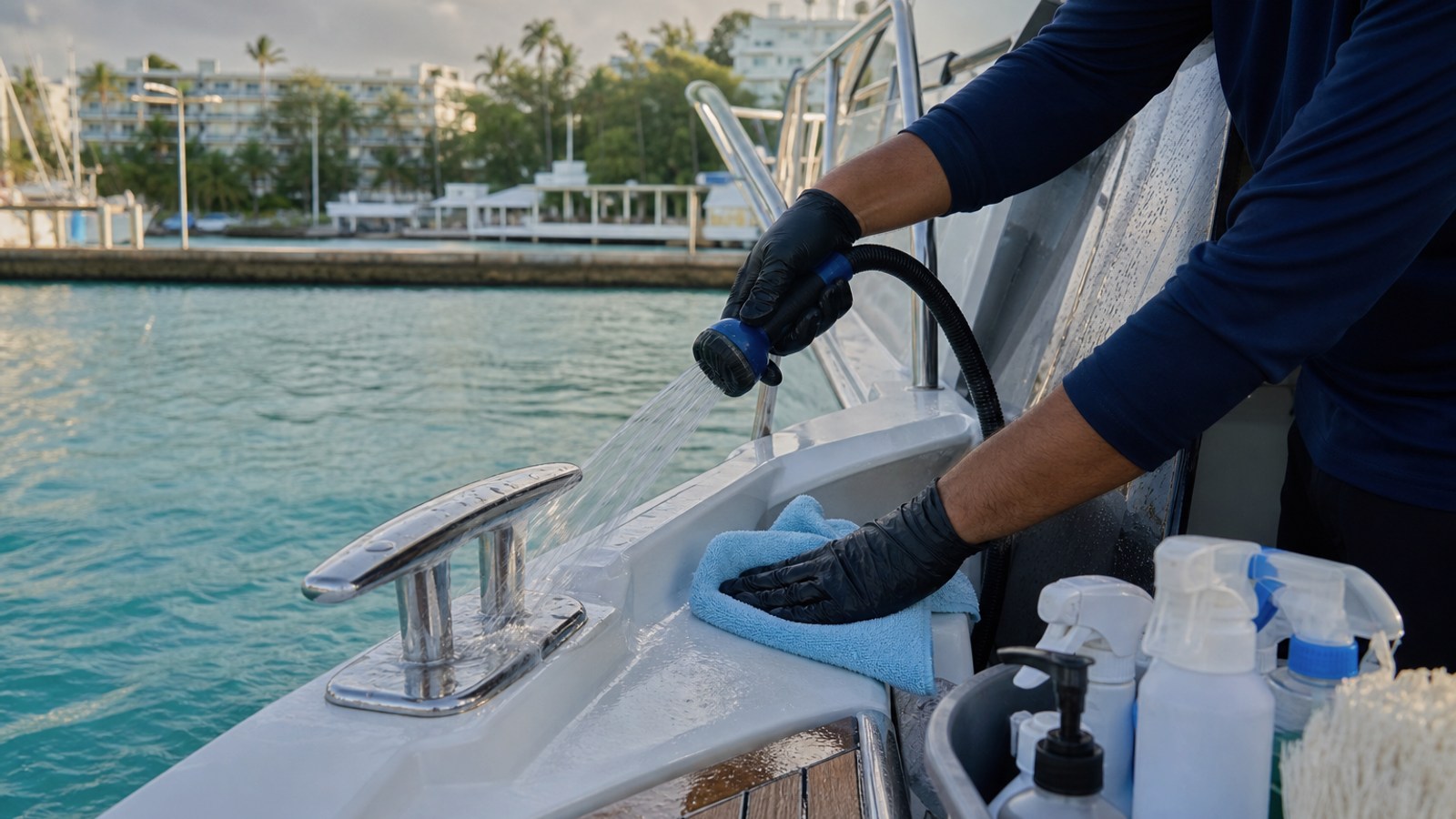
Start high and work down so contamination is not carried back over clean areas. Rinse salt from rails, hardtop supports, exterior glass, deck hardware, and exposed fittings. Wash using clean tools assigned to the correct surface; a brush used on nonskid should not migrate to delicate acrylic or polished finishes.
Pay attention to hidden water. Seat hinges, storage compartments, canvas folds, cupholders, and floor channels can retain moisture after the visible deck looks dry. Ventilation matters in Puerto Rico’s humidity. A boat closed while damp may develop odor and spotting before the next trip.
Use detailing as a regular inspection
A clean vessel communicates. It becomes easier to see early oxidation, a loose fitting, failing sealant, a stain returning from beneath the surface, a cracked stitch, or acrylic beginning to haze. These observations do not replace a qualified marine mechanic or surveyor, but they give the owner better information and a chance to act early.
We encourage owners and captains to note recurring issues. If the same rust trail, water mark, odor, or cushion stain returns after each service, the source needs attention. Repeatedly cleaning the symptom is not a maintenance strategy.
Choose a routine that matches how the vessel is used
A boat used every weekend needs a different plan from a yacht that sits between owner visits. Charter activity, marina exposure, covered storage, material age, and crew habits all change the schedule. Some vessels need a focused post-trip reset with periodic deeper correction. Others need regular checks simply because they remain closed in a hot, humid environment.
Good marine care is disciplined without being complicated. Use compatible products, separate tools, controlled moisture, proper drying, and a consistent inspection sequence. C. Mendez brings that approach to boats and yachts across Puerto Rico, helping owners protect both the experience and the investment.
El mejor detallado ocurre antes de que el desgaste sea permanente
Un día navegando por Fajardo, Culebra, Vieques o la costa sur deja sal en costuras y herrajes, bloqueador en la tapicería y arena en superficies delicadas. Con el calor caribeño, esos residuos se secan rápido.
La rutina correcta comienza al regresar al muelle: retirar residuos dañinos, permitir que todo seque bien y detectar cambios antes de que se conviertan en reparaciones costosas.
Cada superficie necesita su propio método
Gelcoat, fibra de vidrio, acero, acrílico y tapicería no deben tratarse igual. Un limpiador fuerte o una toalla inadecuada puede opacar ventanas, marcar acabados o encerrar humedad en los cojines.
El control del producto, la agitación suave, la extracción cuando corresponde y el secado completo importan más que usar la química más agresiva.
El enjuague es el principio, no el trabajo completo
Trabaje de arriba hacia abajo, use herramientas separadas para superficies delicadas y preste atención al agua escondida en bisagras, compartimentos, lona, portavasos y canales del piso.
La ventilación es fundamental en Puerto Rico. Cerrar una embarcación húmeda puede producir olor y manchas antes del próximo viaje.
Use el detallado como inspección regular
Una embarcación limpia revela oxidación temprana, sellador fallando, costuras abiertas, herrajes flojos o acrílico que comienza a opacarse. Documentar problemas recurrentes ayuda a corregir la causa, no solo el síntoma.
La rutina debe responder al uso real
Un bote usado cada fin de semana necesita un plan distinto al de un yate que permanece cerrado entre visitas. El uso de charter, la exposición de la marina, la edad de los materiales y los hábitos de la tripulación cambian la frecuencia.
C. Mendez aplica una secuencia disciplinada de productos compatibles, herramientas separadas, humedad controlada, secado e inspección para proteger la experiencia y la inversión.